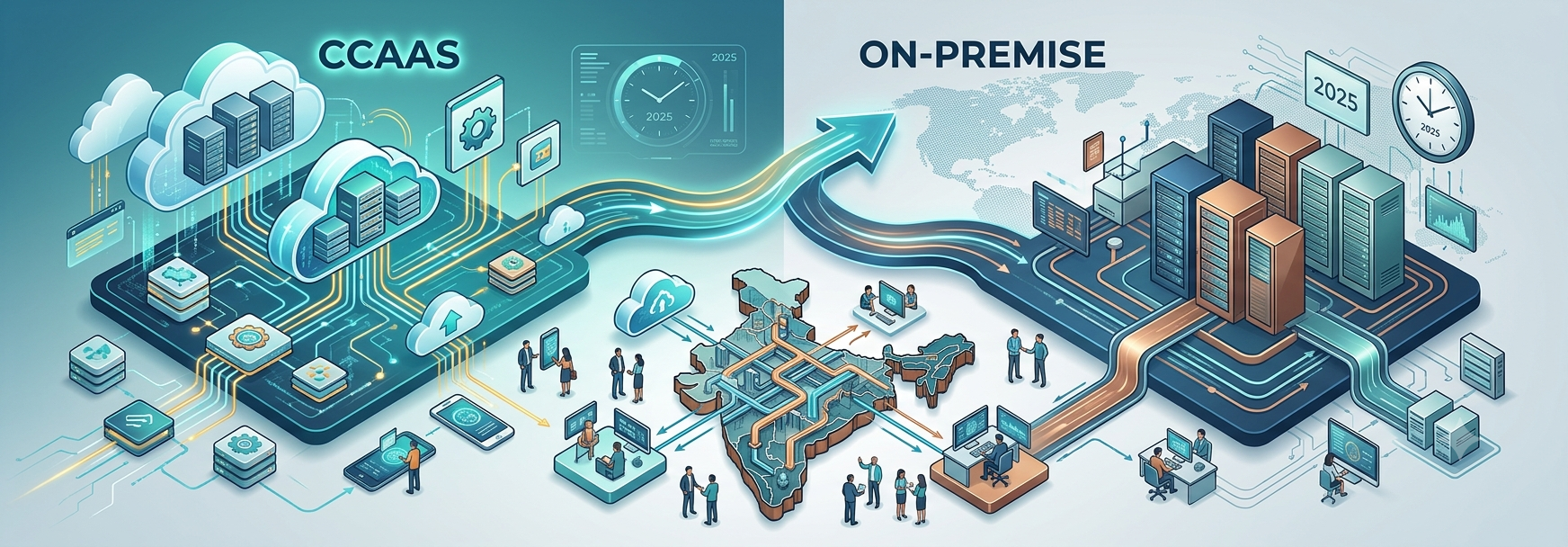
The contact centre technology procurement decision used to be simpler. Before cloud platforms became viable for enterprise scale, on-premise was the only serious option for organisations with significant contact volumes and meaningful security requirements. CCaaS changed the calculus — but not in the straightforward way the vendor narrative suggests. The right answer depends on factors that the standard cloud-versus-on-premise debate consistently fails to address.
What the CCaaS case actually rests on
The case for cloud contact centre platforms rests on four genuine advantages. First, capital expenditure versus operational expenditure — CCaaS eliminates the upfront hardware and infrastructure investment in favour of subscription pricing. For organisations managing tight capital budgets, this is a real advantage. Second, deployment speed — a cloud platform can be operational in weeks rather than the months or years required for complex on-premise implementations. Third, scalability — adding capacity in a cloud environment is an administrative action rather than a hardware procurement and installation project. Fourth, feature velocity — cloud platforms receive continuous updates without requiring organisations to manage their own upgrade cycles.
These are genuine advantages for many organisations. They are also advantages that come with dependencies that enterprise buyers should evaluate carefully before committing.
What the CCaaS case does not adequately address
The conventional CCaaS case underweights three factors that are significant for regulated enterprise organisations. Data sovereignty — the question of where customer data is processed and stored, and under what legal jurisdiction. Data residency requirements are increasingly explicit in financial services, healthcare, and government regulations across multiple markets. When customer data is processed in a multi-tenant cloud environment operated by a vendor headquartered in a different jurisdiction, the regulatory complexity is real and the compliance risk is not theoretical.
Customisation depth is the second underweighted factor. Cloud platforms offer extensive configuration options, but configuration is not the same as customisation. Organisations with complex routing logic, non-standard integration requirements, or specialised compliance workflows sometimes find that cloud platforms accommodate their requirements imperfectly — or that accommodating them requires workarounds that add complexity and maintenance overhead over time.
The third factor is vendor dependency. A contact centre platform is operational infrastructure — one of the most business-critical systems an enterprise operates. The terms under which a cloud vendor can modify pricing, change capabilities, or discontinue services are not always as favourable as the initial contract suggests. Organisations that have built complex workflows on cloud platforms have limited leverage when vendor terms change.
What the on-premise case underweights
On-premise deployments have their own underweighted costs. Total cost of ownership calculations that compare on-premise hardware costs to cloud subscription costs typically undercount the internal IT resource required to maintain, upgrade, and support on-premise infrastructure. The security posture of on-premise deployments depends entirely on the internal security team — there is no vendor security operations centre monitoring for threats. And the feature velocity of on-premise platforms is typically slower, meaning organisations may wait longer for capabilities that cloud customers receive as standard updates.
The case for hybrid and private cloud
The framing of the decision as binary — cloud or on-premise — is itself part of the problem. Modern enterprise contact centre deployments increasingly use hybrid architectures that capture the advantages of both models. Core processing and customer data can remain within the organisation's own infrastructure or a dedicated private cloud environment, while digital channel capacity, overflow handling, and peak-season scaling can use public cloud resources. This approach satisfies data sovereignty requirements, provides the compliance controls that regulated industries require, and still captures the scalability benefits that make cloud attractive.
For enterprise buyers, the practical question is not "cloud or on-premise?" but "which capabilities require sovereign control, which require elasticity, and does the platform I am evaluating support a deployment model that provides both?" Platforms that support genuine hybrid deployment — with the same software and the same capabilities available across on-premise, private cloud, and public cloud models — give enterprises the flexibility to make the right deployment decision for each component of their operation without compromising on capability.
Making the decision
Three questions cut through most of the noise in this decision. Does your regulatory environment specify where customer data must be processed and stored? If yes, the answer must address data residency at the architecture level, not through vendor assurances. Does your organisation have the internal IT capability to operate and secure an on-premise platform at the required standard? If not, managed or cloud deployment is more likely to produce a secure and reliable outcome than an under-resourced on-premise operation. And does the vendor you are evaluating support a deployment model that matches your requirements — or are they asking you to accept a deployment model that works for them?
Discuss deployment options for your organisation with our enterprise team
Wemacx supports cloud SaaS, private cloud, hybrid, and full on-premise deployment — identical capabilities across all models. We can walk through what each means for your specific compliance environment.
Book an Enterprise Demo